NERS accredited HV connection specialists

HV Connections & Substation Design

Complete HV connection packages for developments above 500kVA. 11kV cable design, substation procurement, and all civil and jointing works under one contract.

NERS accredited HV qualified Substation specialist
The Process
1
Load assessment & POC
2
Substation design & procurement
3
11kV cable installation
4
Commissioning & adoption
From POC to Adoption

The Process Step by Step

Every HV connection follows a clear, auditable sequence. Here is exactly what happens at each stage.

1

When HV Is Required

HV connections are required when total demand exceeds the capacity of an LV extension from the NGED network. For most developments, this threshold is around 500 to 800kVA, though it depends on local network conditions. An 11kV supply is brought to an on-site substation, which steps voltage down to 400V LV for distribution around the site. USP carries out a load assessment and preliminary network capacity check to confirm whether HV is required before any formal application is made.

2

Substation Design

Once the HV connection route is confirmed, USP prepares the full substation design. This covers the choice of ground-mounted GRP enclosure or pole-mounted substation, ring main unit (RMU) specification for 11kV switching and supply security, and transformer sizing at 315kVA, 500kVA, or 1,000kVA depending on total demand. Designs are submitted to NGED for approval before procurement and installation proceed. USP manages all NGED design review queries.

3

11kV Cable Installation

With design approval confirmed, USP installs the 11kV XLPE cable connecting the NGED POC to the on-site substation. HV cable (185mm² or 300mm² depending on load) is installed in reinforced ducting at a minimum depth of 600 to 750mm in accordance with ESQCR 2002. All cable jointing is carried out by NGED-approved HV-qualified operatives. Marker tape, route cards, and as-built drawings are produced in NGED format for adoption.

4

Commissioning and Adoption

After installation, the 11kV cable and substation are subject to post-installation testing including insulation resistance tests and pressure testing of cable joints. NGED carries out an adoption inspection before formally taking the HV cable and substation into their asset register. USP prepares all adoption documentation including as-built drawings, test records, material specifications, and welder qualification records. Once adopted, NGED is responsible for ongoing maintenance of the HV network.

Electrical infrastructure works on a development site
Proof on the Ground

See it in action

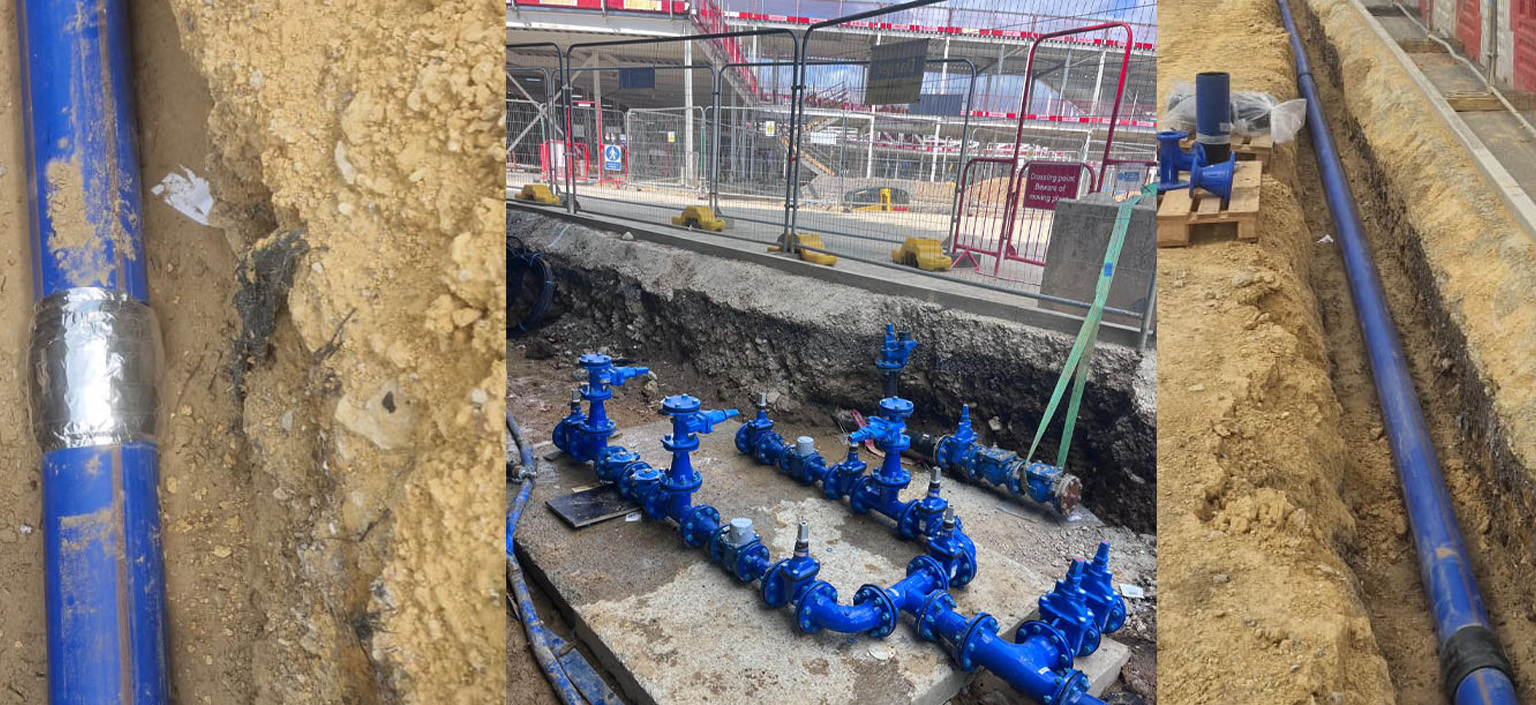
Every HV connection and substation we deliver is NGED tested, adopted, and formally handed over. These are real USP projects, not stock photos.

500+
Electricity connections delivered
50
5-star Google reviews
10+
Industry accreditations
Key Technical Considerations

Technical Specifications

The critical parameters that govern every HV electricity connection and substation installation.

HV cable
11kV XLPE 185mm² or 300mm². Cable size determined by load and route length.
Substation transformer
315kVA, 500kVA, or 1,000kVA. Sized to meet development maximum demand with appropriate headroom.
Ring main unit
11kV switching for supply security. Allows NGED to re-configure supply in the event of a fault.
LV distribution
400V waveform cable from substation secondary to distribution points across the development.
DNO adoption
NGED adopts both the 11kV cable and the substation on completion of post-installation testing and inspection.
Wayleaves
Legal rights for cables crossing third-party land. USP identifies wayleave requirements early and manages the process.
Why Choose USP

What USP Can Do For You

Complete HV connection and substation capability from a single NERS-accredited provider.

Complete HV packages covering 11kV cable design and installation, substation procurement and installation, and LV distribution from substation to plots.
In-house HV design team producing NGED-compliant drawings and documentation, reducing the risk of design rejection and programme delay.
We procure ground-mounted GRP substations from NGED-approved manufacturers, ensuring specification compliance and on-time delivery.
Directly employed NGED-approved HV cable joiners on staff, not subcontracted, providing consistent quality and full programme control.
We manage all NGED adoption documentation from as-built drawings to test records, delivering a clean adoption and avoiding post-completion issues.
Certified Provider

Fully Accredited & Committed to Safety

Every HV connection we deliver meets the highest industry standards. Worker safety, public safety, environmental responsibility, and project compliance from planning to sign-off.

WaterSafe accredited
WIAPS accredited
LRQA WIRS certified
LRQA NERS certified
LRQA GIRS certified
ISO 9001 certified
Achilles UVDB Silver Plus
Constructionline member
SSIP accredited
Acclaim accredited
What Our Clients Say About Us

Rated 5.0 ★★★★★

50 Google Reviews

HV Connections FAQs

Frequently Asked Questions

Once total maximum demand exceeds approximately 500 to 800kVA, NGED will typically require an HV connection and on-site substation rather than a simple LV extension. The exact threshold depends on available spare capacity in the local LV network. USP carries out a load assessment and preliminary network check early in the project to confirm whether LV or HV is required for your scheme.
A substation steps down the 11kV high voltage supply to 400V low voltage for distribution around your development. It contains a ring main unit (RMU) which provides 11kV switching and supply security, and one or more transformers that convert HV to LV. Ground-mounted substations are housed in a GRP (glass-reinforced plastic) enclosure. The LV distribution boards and metering are also located within or adjacent to the substation.
A typical HV connection for a medium-sized development takes 9 to 18 months from initial POC application to energisation. The POC application and connection offer from NGED typically takes 3 to 6 months. Design approval, procurement of the substation, and civil and jointing works then follow. USP programmes all activities from day one and tracks the NGED milestones proactively to keep the programme on track.
The contestable works, which include the 11kV cable installation, substation civil works, and all jointing, are paid for by the developer. NGED's non-contestable charges, which cover the POC connection and adoption activities, are also charged to the developer. Once adopted, NGED takes ownership of the HV cable and substation and is responsible for maintenance thereafter. USP provides transparent costings covering both contestable and non-contestable elements.
A ground-mounted substation is a GRP enclosure installed at ground level, typically on a concrete base. It is the standard choice for larger developments. A pole-mounted substation is mounted on a wooden pole, typically used for smaller rural supplies or where a ground-mounted enclosure is not practical. USP advises on the most appropriate type based on your load, site layout, and NGED requirements.
Get Started

Need an HV Connection
for Your Development?

Tell us about your project and we will send you a free, no-obligation HV connection plan within 24 hours.

100% free, no obligation Response within 24 hours 5.0 from 50 Google reviews

Prefer to talk? Call 024 7542 6505 for immediate service.

Get a Quote